A Comprehensive Guide to Polyurethane Flooring
Polyurethane flooring has emerged as one of the most advanced and reliable flooring solutions for industrial, commercial, and institutional facilities across South Africa. This high-performance system addresses the critical challenges that businesses face daily—from maintaining stringent hygiene standards in food processing plants to withstanding heavy forklift traffic in warehouses. At Tusker Floors, we specialize in polyurethane flooring installations that deliver exceptional durability, chemical resistance, and longevity across diverse applications, from Johannesburg manufacturing facilities to Cape Town commercial kitchens.
Understanding Polyurethane Flooring: The Basics
Polyurethane flooring, often referred to as PU flooring or urethane flooring, is a seamless resin-based floor system that creates a continuous, impermeable surface across any substrate. Unlike traditional flooring materials such as tiles, vinyl, or concrete, polyurethane flooring is applied as a liquid that cures into a solid, extremely durable surface. The magic of polyurethane lies in its chemical composition—it’s created through a reaction between polyols and isocyanates, which form a polymer chain that bonds exceptionally well to prepared concrete substrates.
What sets polyurethane apart from other resin flooring systems, particularly epoxy, is its remarkable elasticity and flexibility. While epoxy flooring systems are known for their hardness and chemical resistance, polyurethane floors offer a unique combination of toughness and resilience that allows them to absorb impacts and accommodate substrate movement without cracking or delaminating. This flexibility makes polyurethane flooring particularly valuable in South African environments subject to thermal shock, mechanical stress, or structural movement—challenges that would cause more rigid flooring systems to fail prematurely.
Key Benefits of Polyurethane Flooring Systems
The growing popularity of polyurethane flooring across South African industrial, commercial, and institutional sectors is driven by tangible performance advantages that deliver real value over the lifespan of a facility. Perhaps the most immediately recognizable benefit is exceptional durability. These systems are engineered to withstand punishing conditions that would quickly destroy conventional flooring materials, from constant forklift traffic in Durban warehouses to thermal stress in Gauteng cold storage facilities.
Chemical resistance is another area where polyurethane flooring truly excels. Food and beverage facilities benefit from polyurethane’s resistance to organic acids, sugars, and cleaning chemicals. Pharmaceutical and healthcare environments appreciate its resistance to aggressive disinfectants and sterilization agents. Manufacturing plants value its ability to withstand petroleum products, solvents, and industrial chemicals without degrading or staining.
The seamless nature of polyurethane flooring creates profound advantages in environments where hygiene and cleanliness are critical. Unlike tiled floors with grout lines, a properly installed polyurethane floor presents an unbroken surface with no joints or crevices where bacteria or contaminants can harbor. This monolithic surface is easier to clean and prevents moisture penetration. For facilities subject to regulatory inspections, this seamless characteristic often makes polyurethane flooring essential for compliance with standards set by the South African Bureau of Standards and the Department of Health.
Types and Variations of Polyurethane Floor Systems
The polyurethane flooring category encompasses a diverse range of system types, each engineered to address specific performance requirements. Self-leveling polyurethane systems represent one of the most popular categories, particularly for spaces requiring smooth, perfectly level surfaces. These fluid formulations flow freely across the substrate before curing, automatically eliminating minor irregularities and creating a glass-smooth finish ideal for environments where cleanliness and ease of maintenance are paramount.
Polyurethane cement systems represent a hybrid technology that combines the resilience of polyurethane with the thermal and chemical resistance of cement-based materials. These systems feature unique chemistry where polyurethane polymers are intimately blended with cementitious materials at a molecular level. The result is exceptional impact resistance, thermal shock resistance, and chemical resistance, making it the gold standard for the most demanding industrial environments, particularly food and beverage processing facilities where hot water washdowns and thermal cycling are daily occurrences.
Polyurethane coatings and sealers represent the thinner end of the spectrum but shouldn’t be dismissed as less important. These systems, typically applied at one hundred to three hundred microns thickness, serve as protective layers over concrete or other substrates. They’re particularly valuable as topcoats over other flooring systems, providing a renewable wear layer that can be reapplied periodically to extend floor life without complete replacement.
Ideal Applications for Polyurethane Flooring
The versatility of polyurethane flooring systems means they find applications across an extraordinarily wide range of South African industries. The food and beverage industry represents perhaps the single largest market, driven by demanding requirements for hygiene, chemical resistance, and thermal performance. From Western Cape wine cellars to KwaZulu-Natal dairy processing plants, polyurethane floors provide the seamless, non-porous surfaces essential for maintaining food safety standards and passing regulatory inspections required by the Department of Agriculture, Land Reform and Rural Development.
Pharmaceutical and healthcare facilities present another natural fit for polyurethane flooring systems. Hospitals, clinics, pharmaceutical manufacturing facilities, and research laboratories all require floors that can withstand aggressive cleaning and disinfection protocols while providing a seamless, non-porous surface that prevents microbial contamination. The chemical resistance enables repeated exposure to hospital-grade disinfectants without degrading, making these floors essential in facilities regulated by the South African Health Products Regulatory Authority.
Manufacturing and industrial facilities across virtually every sector have discovered the performance advantages of polyurethane flooring. Automotive manufacturing plants in the Eastern Cape benefit from resistance to petroleum products and coolants. Electronics assembly facilities utilize conductive polyurethane systems to protect sensitive components from electrostatic discharge. Warehouse and distribution centers throughout Gauteng appreciate its ability to withstand heavy forklift traffic and impact from dropped loads.
Installation Process and Considerations
Achieving the full performance potential of polyurethane flooring depends critically on proper installation procedures executed by experienced professionals. The process begins with comprehensive surface preparation that ensures adequate adhesion and prevents premature failure. The existing substrate, typically concrete, must be thoroughly evaluated for strength, moisture content, and surface contaminants. Concrete should have minimum compressive strength of twenty-five megapascals as per SANS specifications, and any areas of weakness must be repaired before proceeding.
Surface preparation usually involves mechanical methods such as diamond grinding, shot blasting, or scarification to remove surface contaminants while creating the surface profile necessary for mechanical bonding. Moisture testing is absolutely critical, as excess moisture vapor transmission from the concrete slab can prevent proper curing and lead to delamination or bubbling. At Tusker Floors, we utilize calcium chloride testing and relative humidity probe testing to verify moisture levels are within acceptable limits before proceeding.
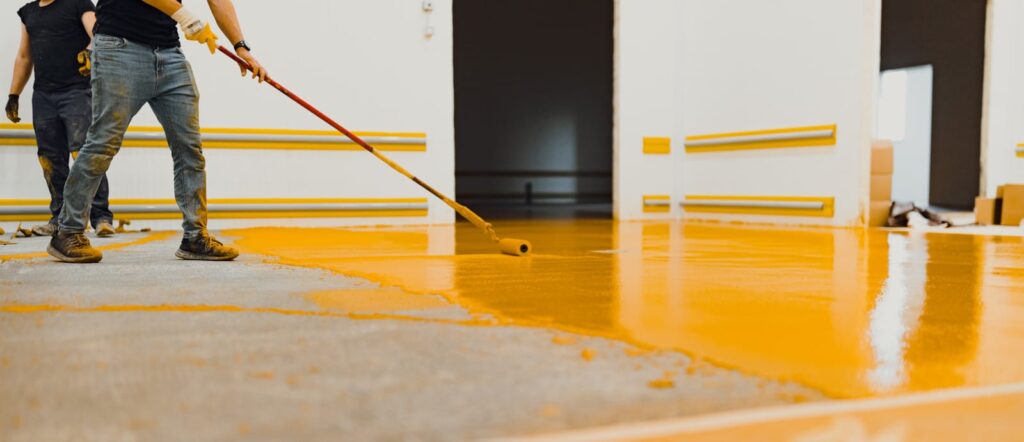
Once the substrate is properly prepared, installation typically begins with primer application specifically formulated to bridge the polyurethane system to the concrete substrate. After the primer cures, main polyurethane layers are applied according to the system design. For self-leveling systems, this involves mixing resin and hardener components in precise proportions, pouring the material onto the floor, and using specialized tools to distribute it evenly and remove entrapped air.
Maintenance and Longevity of Polyurethane Floors
One of the most compelling economic arguments for polyurethane flooring is its exceptional longevity when properly maintained—these floors routinely provide twenty to thirty years of service in demanding South African industrial environments. However, achieving this longevity requires a maintenance program appropriate to the facility’s use. The good news is that maintenance requirements are generally minimal compared to other industrial flooring types.
Daily cleaning typically involves simple sweeping or dust mopping to remove loose debris. For more thorough cleaning, damp mopping with a neutral pH cleaner and clean water effectively removes most soiling without degrading the polyurethane surface. The seamless nature means there are no grout lines to trap dirt—the entire floor can be cleaned with consistent efficiency. In food processing facilities requiring stringent hygiene, regular washdowns with approved sanitizing solutions maintain cleanliness standards without harming the floor.
The environmental sustainability of polyurethane flooring deserves consideration in South Africa’s increasingly climate-conscious industrial landscape. The long service life means fewer replacement cycles and less material waste over the lifetime of a facility. Energy efficiency benefits accrue from polyurethane’s reflectivity—light-colored floors reduce lighting requirements, lowering energy consumption and operational costs. This aligns well with South Africa’s green building initiatives and can contribute to environmental compliance requirements.
Making the Right Choice: Is Polyurethane Flooring Right for Your Facility?
Selecting the optimal flooring system for your South African facility requires careful consideration of multiple factors, from immediate performance requirements to long-term cost of ownership. Polyurethane flooring should be strongly considered when your facility faces moderate to severe thermal cycling, particularly if temperature variations occur rapidly. Cold storage facilities in Cape Town, commercial kitchens in Durban, food processing plants in Johannesburg, and any environment where hot and cold zones interface are ideal candidates.
Chemical exposure is another strong indicator for polyurethane—facilities that regularly work with acids, alkalis, solvents, or aggressive cleaning agents benefit from polyurethane’s tailorable chemical resistance. Hygiene-critical environments almost invariably benefit from polyurethane flooring’s seamless, non-porous surface. If your facility is subject to inspection by municipal health departments or industry regulatory bodies, polyurethane flooring provides the performance necessary to meet and exceed their stringent requirements.
Budget considerations must be evaluated holistically rather than simply comparing initial installation costs. Polyurethane flooring systems typically require higher upfront investment than basic epoxy coatings. However, life-cycle cost analysis reveals a different picture. The exceptional durability means fewer replacement cycles over the life of your facility. Reduced maintenance requirements translate to lower ongoing costs.
Polyurethane flooring is one of the most versatile and high-performing solutions available in South Africa. It is suitable for industrial, commercial, and institutional facilities. Its combination of durability, chemical resistance, thermal shock resistance, and aesthetic flexibility makes it an ideal system for demanding environments. At Tusker Floors, we’re committed to helping our clients select and install the optimal flooring solution for their specific needs. Discover how polyurethane flooring can provide decades of reliable performance for your facility. Contact our team today for a professional consultation.